The Best Time to Visit Nassau: Dry Season, Hurricane Months and the Trade-Off
Updated September 26, 2026 · 7 min read
The Bahamas has a good climate almost all year, which is why the advice you find is usually a shrug with the word “paradise” in it. The useful version is narrower: the seasons here have dates, the wettest month is not the one most people guess, and the months with the real risk are also the months with the real bargains.
Four seasons with actual dates
The climate record for Nassau splits the year like this:
- Cool season: 6 December to 21 March, three and a half months, average daily high below 80 °F (26.7 °C).
- Hot season: 11 June to 3 October, three months and three weeks, average daily high above 87 °F (30.6 °C).
- Drier season: 25 October to 20 May, nearly seven months.
- Wetter season: 20 May to 25 October, with a greater than 21 % chance of any given day being a wet day.
And the two figures that surprise people:
The wettest month in Nassau is June, averaging 4.1 inches (104 mm) of rain. Not August, not September. The driest is December, at 0.9 inches (23 mm) — roughly a quarter of June’s total.
That is the whole climate argument in two numbers. It is also why the peak tourist season and the best weather coincide, and why you pay for it.
What the cool season is actually like
Between December and March you get the driest, clearest, least humid weather of the year, average daily highs in the mid-twenties Celsius, and the high season for arrivals. Prince George Wharf has six berths and can take six ships at once, so the ceiling on how busy the town can get is high.
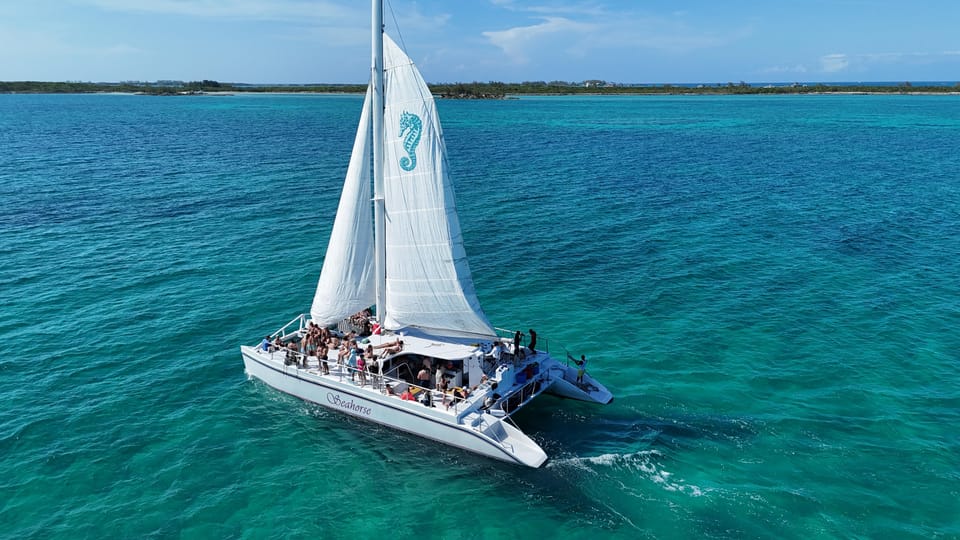
The catch is not the weather on land. It is the sea. Winter is when cold fronts push down from the North American mainland, and a northerly wind turns the crossings to the cays from a flat twenty-five minutes into something considerably less comfortable. The boats still run. One catamaran operator’s own listing tells passengers to bring a beach towel especially December–March — a quiet admission about winter crossings that is worth more than any brochure.
If you are prone to seasickness and travelling in winter, that is the argument for a catamaran over a powerboat, and for a morning departure.
Hurricane season, honestly
The Atlantic hurricane season runs 1 June to 30 November. Most activity falls between mid-August and mid-October, and the climatological peak — the date on which, averaged over a century of records, the most storms have been active — is 10 September.
Two things need saying about this, and they point in opposite directions.
It is a real risk, not a theoretical one. Hurricane Dorian struck the Abaco Islands on 1 September 2019 with maximum sustained winds of 185 mph, tying the 1935 Labor Day hurricane for the strongest winds ever recorded at an Atlantic landfall. It then hit Grand Bahama at similar strength and stalled just north of it for at least 24 hours. NOAA calls it the strongest hurricane in modern history to make landfall in the Bahamas. At least 70,000 people were left homeless.
And the Bahamas is an archipelago, not an island. Dorian’s landfalls were on Abaco and Grand Bahama. Neither is New Providence, where Nassau is. A storm that flattens one island group can leave another with a wet week. That is not reassurance — it is the reason blanket statements about “the Bahamas in September” are useless in both directions.
What follows practically: if you travel between August and October, book things that state a weather clause. Some operators write it in plainly — one Nassau tour states that if your cruise ship cannot dock because of bad weather you get a full refund. Free cancellation up to 24 hours ahead is a weaker promise, because 24 hours ahead you often still do not know. And travel insurance that covers weather disruption stops being optional in these three months.
What is in season to eat
Worth folding into the decision, because it changes the menu rather than the weather.
Crawfish — spiny lobster — is closed from 1 April to 31 July. Nassau grouper is closed from 1 December to 28 February. So a February visit is the best weather and no local grouper; a May visit has neither lobster nor the driest air. Conch is the only one of the three available every month, which is why it is the honest thing to order.
Month by month, briefly
- December to mid-March — driest and clearest, coolest air of the year, high season, highest prices. Best for a town-and-culture trip; the boat days are the ones that suffer.
- Late March to May — still inside the drier season until 20 May, and warming towards the hot season. No local lobster from 1 April.
- June — the hot season starts on 11 June and June is the wettest month of the year. The hurricane season is open, but its peak is more than two months away.
- July and August — hot, humid, and inside the stretch where storm activity climbs towards the September peak.
- September and the first half of October — the period around the 10 September peak. This is the gamble: for a flexible traveller with insurance and a refundable booking, a defensible one.
- Late October and November — the drier season restarts on 25 October and the hurricane season ends on 30 November. Late November is one of the most underrated windows here: dry, warm water, pre-Christmas prices.
The short answer
For the best weather, February. For the best combination of weather, price and space, late April to mid-May or the second half of November. For the cheapest trip you are willing to insure, September.
If your dates are fixed and they fall in the wet or storm months, the decision that matters is not which month but which operators — the ones that publish a weather clause and a refund, not the ones that publish a saving.
Related: the 41 boat trips from €58.60, the 25 beach club days from €51.80, and which beach club day is which.